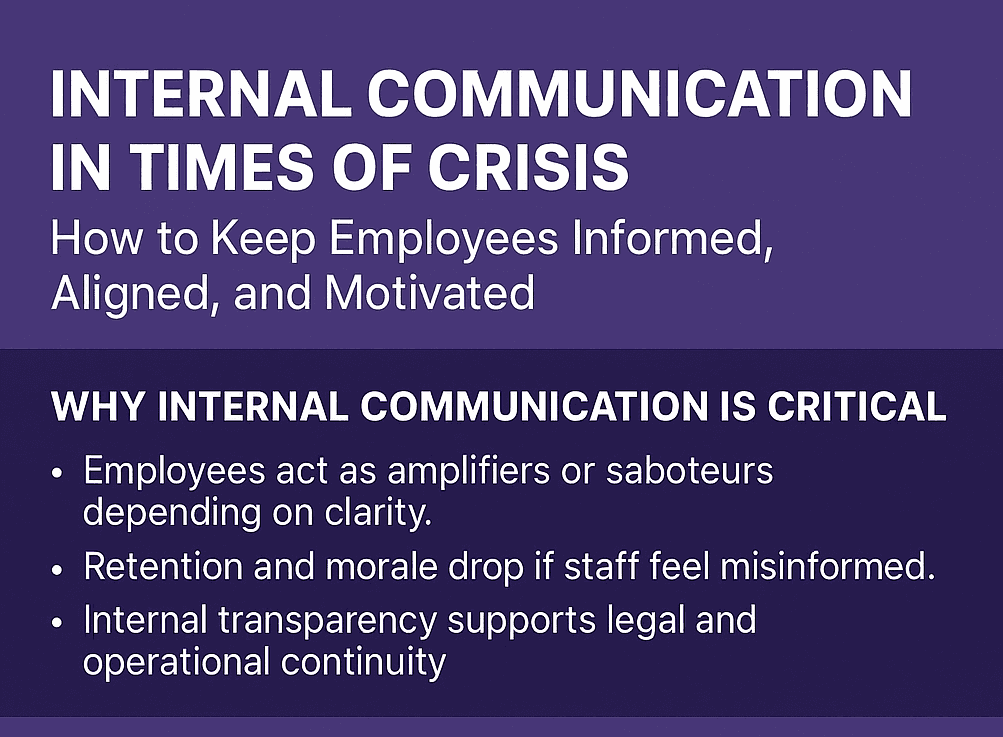
Your employees are not just bystanders in a crisis — they’re your first audience. Yet, many companies neglect internal communication, leading to rumors, demotivation, leaks, and even resignations.
Why Internal Communication Is Critical
• Employees act as amplifiers or saboteurs depending on clarity.
• Retention and morale drop if staff feel misinformed.
• Internal transparency supports legal and operational continuity.
How to Communicate with Your Team in a Crisis
1\. Start with a leader’s message.
Employees want to hear from the top — not just HR.
2\. Share what is known — and what isn’t.
Uncertainty is better than false certainty.
3\. Create a communication cadence.
Daily or weekly updates reduce speculation.
4\. Use multiple formats.
Email, video briefings, intranet FAQs — not just memos.
5\. Encourage upward feedback.
Let staff ask questions anonymously to reduce tension.
If Layoffs Are Involved
• Use empathetic, plain language.
• Clearly outline next steps (benefits, help, timeline).
• Do not hide behind legal jargon.
• Provide managers with talking points — they’re the front line.
Our Internal Comms Services
We help build
• Internal comms plans under pressure
• FAQ databases and talking points
• Video scripts from executives
• Crisis intranet announcements
📩 Want to keep your team together when the pressure hits? Let’s talk
[info@sic-group.us](mailto:info@sic-group.us) | [+1 240 234 5187](tel:+12402345187) | [www.sic-group.us](http://www.sic-group.us/)